





Solenoids
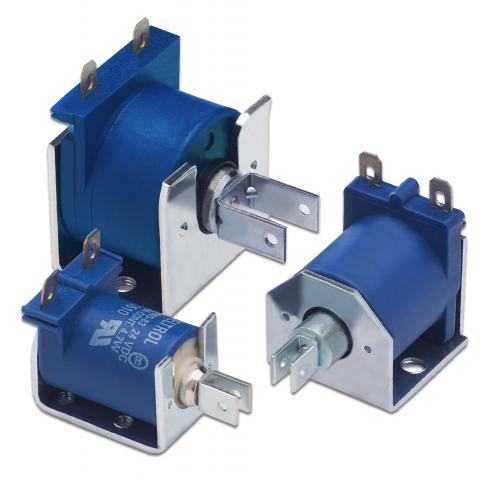
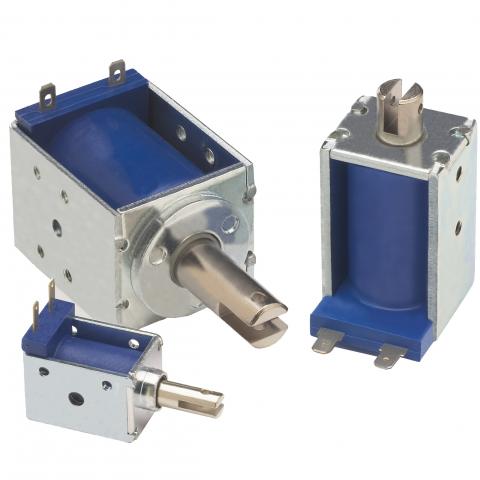
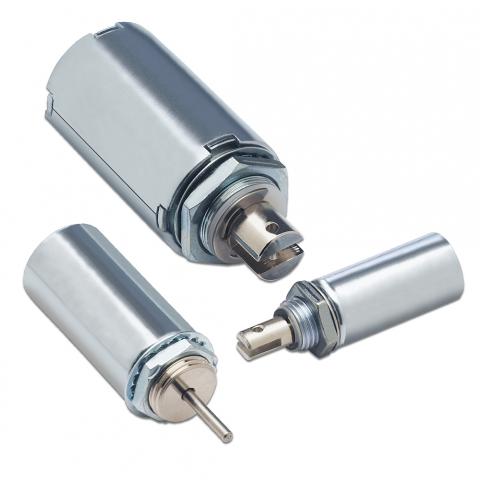
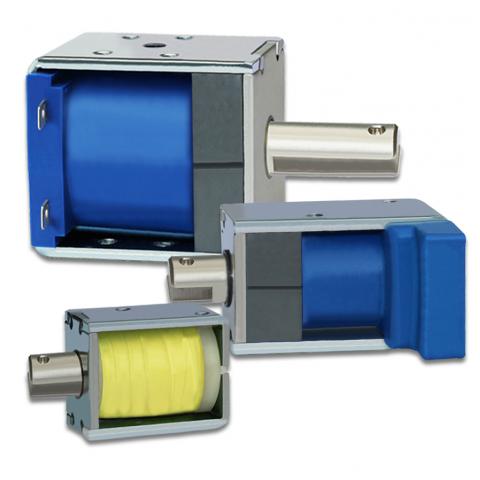
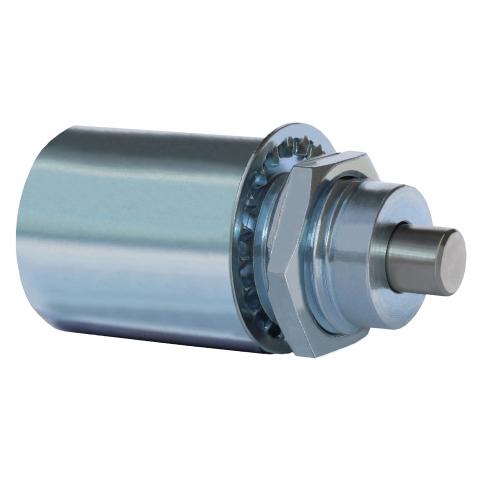
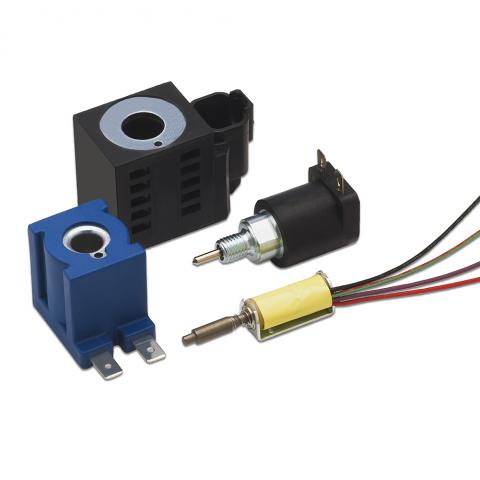
Deltrol Controls offers an extensive line of AC and DC linear solenoids.
Features
- C-frame, D-Frame, and tubular constructions
- Magnetic latching options available
- Class F (155° C) encapsulated coils on many models
- UL certification or insulation systems
- Custom designs available upon request (min quantities apply)
Typical applications: Appliances, generators, printing equipment, HVAC, security, beverage dispensing equipment, energy management systems, commercial laundry equipment, medical equipment, small engines, motorcycle aftermarket, valves, gaming equipment, office equipment, vending equipment, and many more.
FAQs
What is a latching solenoid?
A latching solenoid (also called a bistable solenoid or magnetic latching solenoid) is a solenoid that uses a permanent magnet to hold its position — either open or closed — without requiring continuous electrical power. A brief pulse of current in one direction moves the plunger to the energized position; a pulse in the opposite direction (or a second coil) returns it. Because it only draws power during the transition, a latching solenoid uses significantly less energy than a continuously energized standard solenoid, making it ideal for battery-operated equipment and applications where power consumption matters.
What is the difference between AC and DC solenoids?
AC solenoids are powered by alternating current (typically 24VAC, 120VAC, or 240VAC) and produce a buzzing sound during operation due to the alternating magnetic field. They tend to have higher inrush current and generate more heat during sustained energization. DC solenoids are powered by direct current (typically 12VDC or 24VDC) and operate silently with a steady pull force. DC solenoids are preferred for electronically controlled equipment, mobile applications, and anywhere quiet operation or precise current control is needed. AC solenoids are common in line-powered appliances and industrial equipment.
Can solenoids be custom wound for non-standard voltages?
Yes. Deltrol specializes in custom solenoid coil winding for OEM applications. If your equipment uses a non-standard voltage — such as 48VDC, 36VAC, or a specific current rating — Deltrol can wind coils to your specification. Custom winding also allows optimization of coil resistance, duty cycle, and temperature rating for your specific operating environment. Provide your supply voltage, available current, duty cycle, and operating temperature range to receive a custom coil specification.
What is a C-frame solenoid used for?
A C-frame solenoid (named for its C-shaped steel frame) is a compact, open-frame solenoid design commonly used in relays, switches, valve actuators, door locks, and light-duty industrial automation. The C-frame design is economical and easy to mount, making it popular in OEM appliances and equipment where space is constrained. Deltrol manufactures C-frame solenoids in both AC and DC versions across a range of frame sizes (C4 through C9) with AC and DC coil options.
What is the duty cycle of a solenoid, and why does it matter?
Duty cycle is the percentage of time a solenoid is energized in a given cycle. A 100% duty cycle means the solenoid is continuously energized. Most solenoids are rated for intermittent duty — for example, 25% or 50% duty cycle — meaning they can only be energized for that fraction of time before they overheat. Exceeding the rated duty cycle causes coil temperature to rise, accelerating insulation breakdown and shortening solenoid life. If your application requires continuous energization, specify a solenoid rated for continuous duty, or use a latching solenoid which holds position without drawing power.
How do I specify a custom solenoid?
To specify a custom solenoid from Deltrol, provide: (1) Supply voltage and current (AC or DC, voltage, and available current). (2) Force or stroke requirement — the push or pull force needed and the distance the plunger must travel. (3) Duty cycle — how often and how long the solenoid will be energized. (4) Operating temperature range — ambient and fluid temperatures the solenoid will experience. (5) Mounting configuration — how it will be attached to your equipment. (6) Frame size constraints — the maximum envelope available. (7) Volume — estimated annual quantity. Deltrol's engineering team will use these inputs to select or design the appropriate frame size, coil winding, and plunger configuration.
What is the difference between a C-frame and D-frame solenoid?
C-frame solenoids use an open C-shaped steel frame and are compact, economical, and suited for light-to-medium duty applications. D-frame solenoids use a tubular or D-shaped enclosure that provides better magnetic efficiency, higher force output for a given size, and more protection from the environment. D-frame solenoids are preferred for higher-force applications, longer stroke requirements, and environments with exposure to moisture or debris. For a given envelope size, a D-frame will generally deliver more force and better heat dissipation than a C-frame.
What causes a solenoid coil to burn out?
Solenoid coil burnout is almost always caused by one of these conditions: (1) Overvoltage — applying more than the rated voltage increases current and heat exponentially. (2) Exceeding duty cycle — energizing longer than the coil is rated for causes heat buildup. (3) Mechanical binding — if the plunger is prevented from moving (by a stuck valve or debris), the coil draws locked-rotor current continuously, dramatically increasing heat. (4) Ambient temperature too high — operating above the coil's temperature rating degrades insulation over time. (5) Incorrect voltage type — applying DC to an AC-rated coil (or vice versa) can cause immediate failure.
Are Deltrol solenoids available for hazardous locations?
Deltrol manufactures solenoids for a range of industrial environments. For hazardous location (HAZLOC) requirements such as UL Class I Division 2 or ATEX certifications, contact Deltrol's engineering team with your specific classification, gas group, and temperature code requirements. Custom enclosures and coil configurations can be engineered for explosion-proof or intrinsically safe applications.
What is the stroke length of a solenoid, and how do I choose the right one?
Stroke length is the distance the solenoid plunger travels from its rest position to its fully energized position. Common stroke lengths range from 1/16 inch to 1 inch depending on the solenoid frame size and application. A longer stroke generally requires more force to achieve, so larger frame sizes are needed for long-stroke applications. When selecting stroke length, match it to the mechanical displacement your application requires — for example, the lift distance of a valve poppet or the travel of a locking pin. Deltrol can match stroke and force to your application geometry.